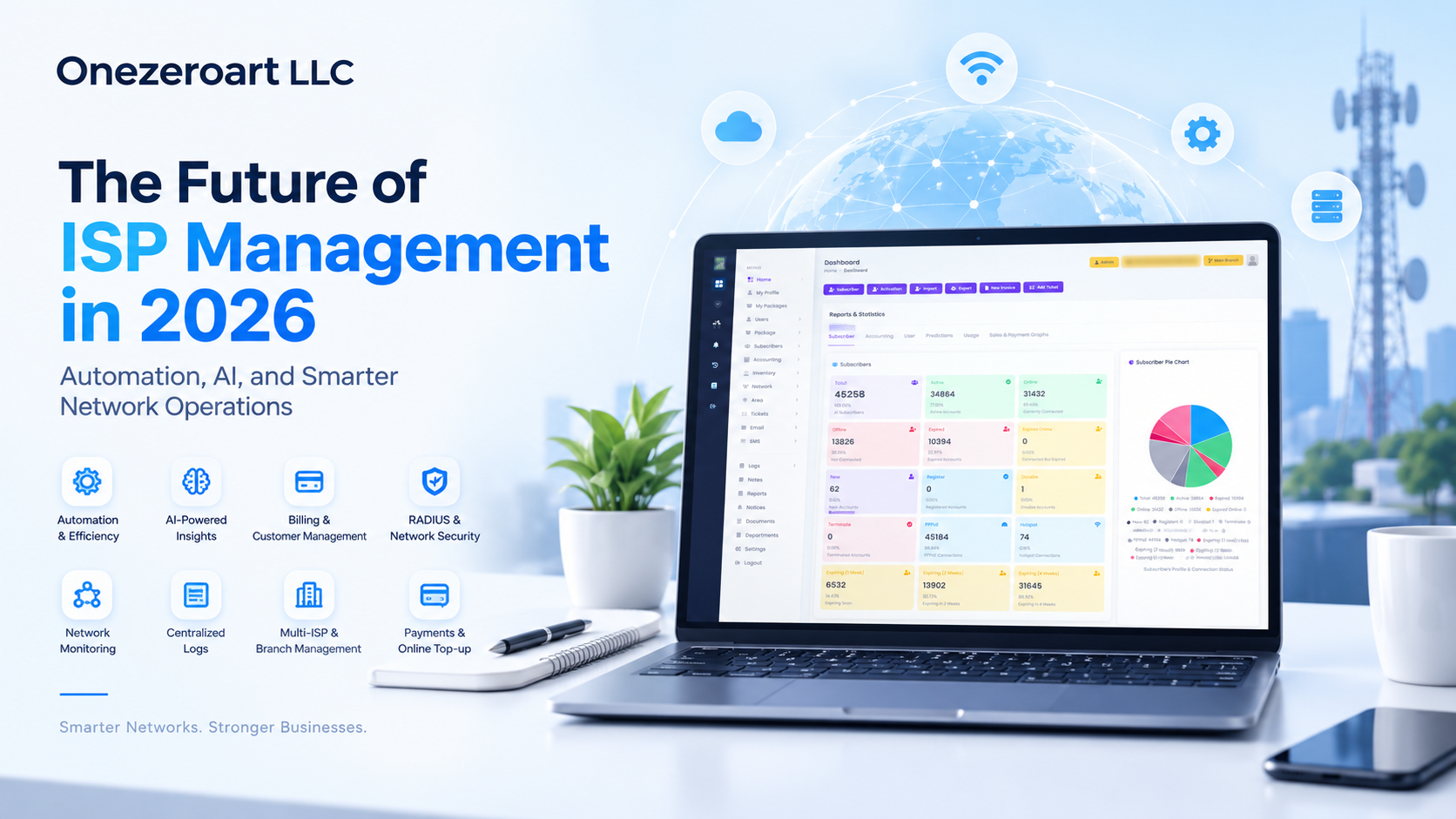
The Future of ISP Management in 2026: Automation, AI, and Smarter Network Operations
The internet service provider (ISP) industry is changing quickly.
As subscriber numbers grow, networks become more complex, customer expectations increase, and competition becomes stronger, many ISPs are moving away from manual processes and disconnected tools.
In 2026, the biggest change is not only faster internet or better networking hardware. The real transformation is happening in how ISPs manage their customers, billing, networks, support, and daily operations.
Automation, artificial intelligence (AI), centralized management, real-time monitoring, and integrated ISP software are becoming increasingly important for reducing manual work and improving operational efficiency.
For a small ISP with 50 or 100 customers, manual processes may still seem manageable. But when the subscriber base grows to 500, 1,000, or more customers, the same processes can quickly become a source of errors, delays, and unnecessary workload.
So, what does the future of ISP management look like in 2026?
Let's explore the major changes shaping modern ISP operations and how providers can prepare for the next stage of growth.
The ISP Industry Is Moving Toward Automation
One of the most important trends in ISP management is automation.
Traditional ISP operations often require staff to perform repetitive tasks such as:
- Creating customer accounts
- Generating monthly invoices
- Checking unpaid bills
- Suspending expired connections
- Reconnecting customers after payment
- Sending payment reminders
- Updating customer information
- Checking network status
- Reviewing logs
- Creating reports
When these tasks are performed manually, the risk of human error increases.
Automation allows an ISP to define rules and let the system perform repetitive operations automatically.
For example:
Customer package expires → System checks account → Service is suspended → Customer receives notification → Customer makes payment → Service is restored.
Instead of requiring a staff member to complete every step, the system can handle the workflow based on predefined rules.
This is particularly valuable for growing ISPs because increasing customers does not necessarily have to mean increasing administrative workload at the same rate.
AI Will Become More Useful in ISP Operations
Artificial intelligence is receiving significant attention across the technology industry, and ISP operations are no exception.
However, AI in ISP management should not be viewed simply as a chatbot.
The more practical opportunity is using AI to help teams analyze information, identify patterns, reduce repetitive work, and support better decisions.
An ISP can have large amounts of information coming from:
- Customer accounts
- Billing records
- Network devices
- RADIUS authentication
- System logs
- Support tickets
- Bandwidth usage
- Payment activity
Human teams can review this information, but doing so manually becomes increasingly difficult as the network grows.
AI-assisted systems can potentially help identify unusual patterns, highlight important events, summarize information, or help support teams investigate problems faster.
For example, instead of a technician manually reviewing thousands of log entries, an intelligent system could help identify events that deserve attention.
The goal is not to replace network engineers.
The goal is to give engineers better information faster.
Smarter ISP Billing and Customer Management
Billing is one of the most important parts of ISP operations.
A billing problem can quickly become a customer support problem.
Consider a simple scenario.
A customer has an internet package that expires at the end of the month. If the ISP relies on manual processes, someone may need to check the account, generate the invoice, send a reminder, suspend the connection, and later reconnect the service after payment.
For hundreds or thousands of subscribers, this becomes difficult to manage consistently.
Modern ISP management platforms can connect billing, customer management, RADIUS, payments, and network automation into a single workflow.
A typical workflow can look like this:
Customer → Package → Billing → Payment → RADIUS → Network Service
When these systems communicate with each other, many routine operations can happen automatically.
This is one reason integrated ISP CRM and billing software is becoming increasingly important for modern providers.
RADIUS and Network Automation Will Become More Important
RADIUS remains an important part of many ISP networks, particularly for subscriber authentication and access management.
But modern ISP management is increasingly moving beyond simply running a RADIUS server.
ISPs want their customer management and network systems to work together.
For example:
CRM creates subscriber → RADIUS account is created → Customer connects → Package rules are applied → Payment status changes → Service is updated automatically.
This type of integration can significantly reduce repetitive configuration work.
For ISPs using MikroTik and other supported network equipment, API-based automation can provide even more control over subscriber management and network operations.
Instead of manually logging into routers and changing individual customer settings, administrators can manage many operations from a centralized platform.
Real-Time Network Monitoring Will Become a Standard Requirement
Another major change is the growing importance of real-time network visibility.
In the past, an ISP might discover a network problem after customers started calling support.
That approach is reactive.
Modern ISP operations aim to become more proactive.
Instead of waiting for customers to report a problem, network teams can monitor important infrastructure and look for signs of trouble.
Useful information can include:
- Router availability
- Interface status
- Traffic levels
- Device health
- Connection failures
- Authentication problems
- Server events
- Network errors
- System logs
The objective is simple:
Detect problems before they become major customer-facing incidents.
For a growing ISP, this can make a significant difference to the workload of the NOC and support team.
Centralized Logs Will Become More Valuable
As an ISP grows, the number of devices producing logs also grows.
A network may contain:
- MikroTik routers
- Core routers
- Switches
- Servers
- RADIUS servers
- Firewalls
- VPN systems
- Monitoring systems
- Other network infrastructure
If each device stores logs separately, troubleshooting can become slow.
A centralized log management system brings information into one location where network teams can search and analyze events more easily.
This is particularly useful when investigating questions such as:
- When did the problem start?
- Which device generated the event?
- Which user or service was affected?
- Did multiple devices report similar errors?
- Was there an authentication failure?
- Did a configuration change occur before the problem?
ABC Syslog can support this approach by providing centralized log collection, search, monitoring, and alerting for network and server infrastructure.
Customer Self-Service Will Reduce Support Pressure
Customers increasingly expect immediate access to information.
They do not always want to call support to ask:
- What is my package?
- When does my package expire?
- How much do I need to pay?
- Has my payment been received?
- Can I renew my connection?
- What is my account status?
A customer portal can provide these answers directly.
Modern ISP CRM platforms can provide customer-facing portals where subscribers can view account information, invoices, payments, services, and other relevant information.
This creates a better experience for customers while reducing repetitive questions for support teams.
The result is simple:
Customers get faster information, while support teams spend less time answering routine questions.
Payment Automation Will Become a Core Part of ISP Management
Online payments are also becoming increasingly important for ISPs.
Manual payment collection can create unnecessary administrative work.
Modern ISP systems can connect customer billing with supported payment gateways so that payment information can flow back into the billing system.
A simplified workflow looks like this:
Invoice generated → Customer receives notification → Customer pays online → Payment confirmed → Account balance updated → Service status updated
The exact workflow depends on the ISP's payment provider and software configuration, but the principle remains the same: reduce the number of manual steps between payment and service management.
For ISPs serving large numbers of customers, even small improvements in this workflow can save considerable staff time.
Data Will Become More Important for ISP Decision-Making
Modern ISP management is increasingly data-driven.
ISPs have access to information about:
- Subscriber growth
- Package popularity
- Payment behavior
- Customer activity
- Network performance
- Support requests
- Service usage
- Revenue
- Reseller performance
The challenge is turning this information into useful decisions.
For example, an ISP might discover that a particular package is consistently popular among customers in a specific area.
That information could help the business decide whether to introduce additional capacity or create a new package.
Similarly, billing and customer data can help identify customers who may be interested in upgrading their internet package.
Instead of relying only on assumptions, ISP managers can use operational data to make better decisions.
Automation Will Change the Role of ISP Staff
Automation does not necessarily mean fewer people.
Instead, it can change how employees spend their time.
Consider a support employee who currently spends several hours each day:
- Checking unpaid accounts
- Suspending expired users
- Reconnecting paid users
- Sending payment reminders
- Updating customer records
If these processes become automated, that employee can spend more time on tasks that require human judgment.
For example:
- Solving complex customer issues
- Investigating network problems
- Improving customer experience
- Monitoring service quality
- Supporting business growth
- Handling escalations
This is an important distinction:
Good automation removes repetitive work, not the need for skilled people.
What a Modern ISP Management System Should Look Like
As these technologies come together, the modern ISP management platform is becoming more integrated.
Instead of using completely separate systems for every operation, ISPs can connect important functions through a centralized platform.
| Area | Modern Approach |
|---|---|
| Customer Management | Centralized ISP CRM |
| Billing | Automated invoicing and account management |
| Authentication | RADIUS integration |
| Network | MikroTik/API and network automation |
| Payments | Online payment gateway integration |
| Notifications | Automated customer alerts |
| Support | Tickets and customer portal |
| Monitoring | Real-time network visibility |
| Logs | Centralized log management |
| Reporting | Automated operational reports |
| Access Control | Role-based staff and reseller management |
The goal is not simply to have more software.
The goal is to connect the right systems so information can move between them automatically.
How ISPs Can Prepare for the Future
ISPs do not need to automate everything at once.
A better approach is to identify the most repetitive and error-prone processes first.
Step 1: Identify Manual Tasks
Write down everything your team does manually every day or every month.
For example:
- Billing
- Account suspension
- Payment verification
- User creation
- Package changes
- Customer notifications
- Router configuration
- Log investigation
- Reporting
Step 2: Prioritize High-Impact Processes
Start with processes that consume the most staff time or frequently create errors.
Billing and package expiry are often good starting points because they follow predictable rules.
Step 3: Connect Your Systems
Look for opportunities to integrate:
CRM + Billing + RADIUS + Network Devices + Payments + Notifications
The more disconnected your systems are, the more manual work your team usually needs to perform.
Step 4: Improve Network Visibility
Make sure your NOC team can quickly understand what is happening across the network.
Monitoring and centralized logging can help reduce troubleshooting time.
Step 5: Use AI Carefully
AI should be introduced where it provides practical value.
Use it to assist with:
- Data analysis
- Event summarization
- Troubleshooting support
- Pattern detection
- Documentation
- Customer support workflows
Do not introduce AI simply because it is a popular technology.
Start with a real operational problem and determine whether AI can solve it effectively.
Where Zal Ultra Fits Into Modern ISP Management
For ISPs looking to bring customer management, billing, RADIUS, network automation, payments, support, and reporting into a more connected environment, an integrated ISP CRM can simplify daily operations.
Zal Ultra is an all-in-one ISP CRM and management platform with capabilities around customer management, billing, RADIUS, MikroTik/API integration, payments, automation, tickets, reports, and customer portal functionality.
Instead of managing every operation independently, an ISP can use a centralized system to connect business and network workflows.
This approach is particularly useful for ISPs that are growing and finding that spreadsheets and disconnected tools are becoming difficult to manage.
For ISPs that need centralized logging alongside their CRM and network operations, ABC Syslog can complement the environment by providing centralized log collection, search, monitoring, and alerting.
The important principle is not choosing more software.
It is building an environment where the systems you already depend on can work together efficiently.
The Future Is Smarter, Not Simply More Automated
The future of ISP management will not be defined by one technology.
AI alone will not solve ISP operational problems.
Automation alone will not solve them either.
The real opportunity comes from combining several technologies:
Automation + AI + CRM + RADIUS + Network APIs + Payments + Monitoring + Centralized Logs + Data
When these technologies work together, ISPs can reduce repetitive tasks, improve visibility, respond to problems faster, and provide a better customer experience.
For smaller ISPs, this transformation can also create an opportunity to compete with larger providers without building huge administrative teams.
The key is to start early.
You do not need to automate your entire ISP overnight. Start with one repetitive process, measure the improvement, and gradually expand.
Conclusion
ISP management in 2026 is moving toward a more connected, automated, and data-driven model.
Manual billing, disconnected systems, reactive troubleshooting, and repetitive administrative work can make it difficult for an ISP to scale efficiently.
The next generation of ISP operations will increasingly depend on systems that can communicate with each other and automate predictable workflows.
For ISP owners and managers, the question is no longer simply:
“Do we need automation?”
A better question is:
“Which part of our ISP should we automate next?”
By gradually adopting automation, AI-assisted workflows, integrated CRM and billing, RADIUS and network automation, centralized monitoring, and log management, ISPs can build an operation that is easier to manage today and better prepared for tomorrow.
Ready to Build a Smarter ISP?
Explore how integrated ISP management tools can help your team automate daily operations, manage subscribers, simplify billing, and improve network visibility.
Discover Onezeroart's ISP solutions and see how Zal Ultra, Zal Pro, and ABC Syslog can fit into your ISP workflow.


