10 Customer Retention Strategies Every Growing ISP Should Use in 2026
Getting a new internet subscriber is important for every ISP. But keeping that subscriber for years is even more valuable.
As competition increases, customers have more choices than ever. A subscriber may leave because of repeated downtime, slow support, billing problems, poor communication, or simply because another provider offers a better experience.
For a growing ISP, losing customers regularly can become a serious business problem.
Imagine an ISP adding 100 new subscribers every month but losing 80 existing customers during the same period. On paper, the business is growing. In reality, the net growth is only 20 customers.
This is why customer retention should be an important part of every ISP's growth strategy in 2026.
Customer retention does not mean giving every customer a discount. It means understanding what customers need, providing reliable service, solving problems quickly, and making the overall experience simple.
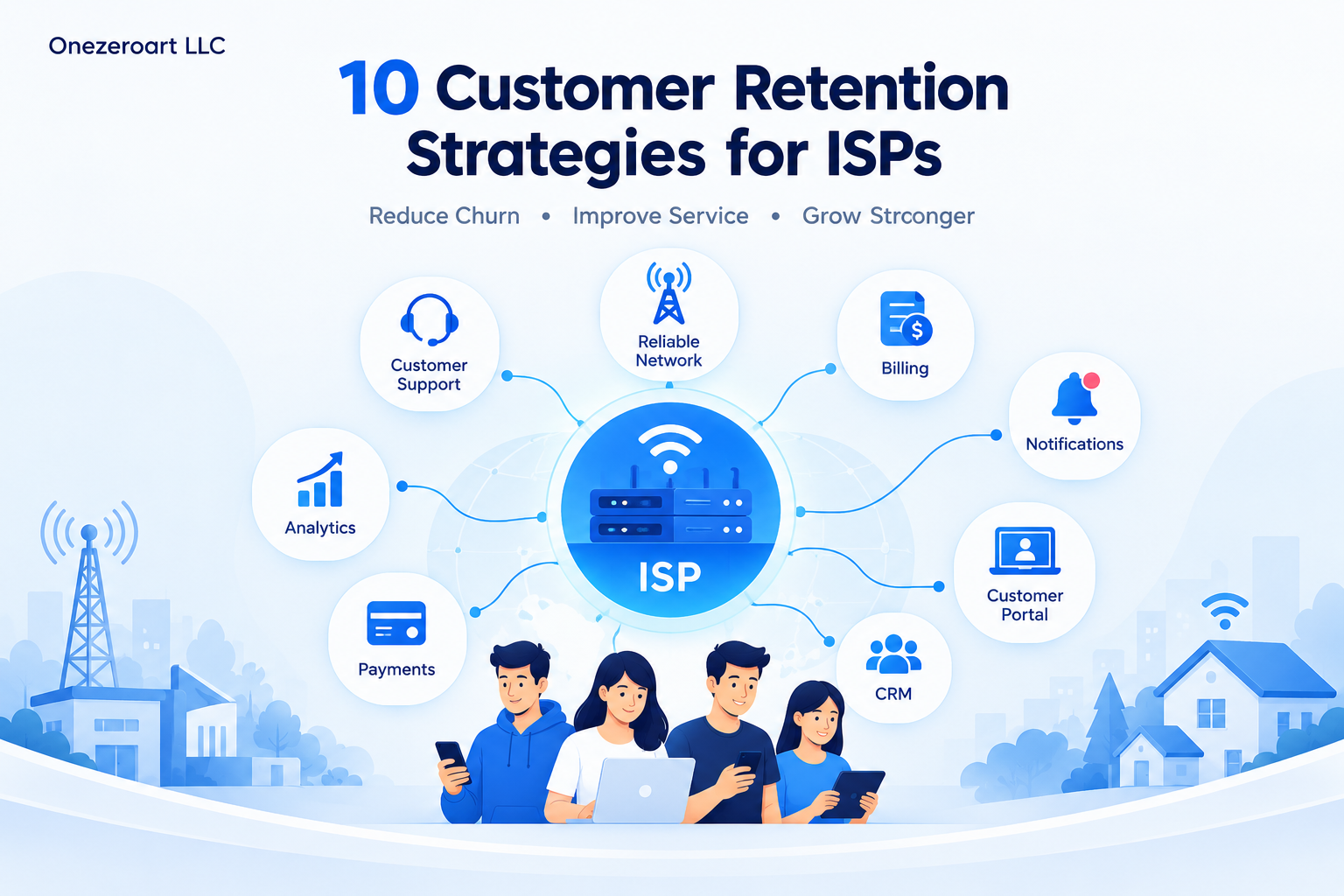
In this article, we will look at 10 practical customer retention strategies for ISPs and how technology can help providers build stronger, long-term customer relationships.
Why Customer Retention Matters for ISPs
Internet service is a recurring business.
A customer who stays with an ISP for several years can generate much more long-term value than a customer who joins and leaves after a few months.
Customer retention can help ISPs:
- Maintain predictable recurring revenue
- Reduce the pressure to constantly acquire new customers
- Build stronger customer relationships
- Increase referrals
- Improve brand reputation
- Reduce customer acquisition costs
- Create opportunities for package upgrades
Retention also provides an important business advantage.
When customers stay longer, an ISP can spend more time improving its network and service instead of constantly replacing customers who have left.
So the goal should not only be:
“How can we get more subscribers?”
It should also be:
“How can we give our existing subscribers a reason to stay?”
1. Provide Reliable Internet Service
The first and most important retention strategy is simple:
Give customers a reliable connection.
Marketing can attract a customer, but network performance is what keeps them.
Frequent downtime, unstable connections, packet loss, or inconsistent speeds can quickly frustrate subscribers.
ISPs should continuously monitor important network infrastructure and identify problems before they affect a large number of customers.
A proactive approach can include monitoring:
- Core routers
- Access devices
- Interfaces
- Traffic levels
- Network availability
- Authentication services
- Servers
- Critical infrastructure
When the technical team knows about a problem before customers start calling, the ISP has a better chance of resolving it quickly.
Reliable service is the foundation of customer retention.
2. Respond to Customer Problems Quickly
Even a well-managed network will occasionally experience problems.
What matters is how quickly the ISP responds.
Customers become frustrated when they report an issue and receive no clear response.
A good support process should make it easy to:
- Receive the complaint
- Create a support ticket
- Assign it to the right staff member
- Investigate the problem
- Update the customer
- Resolve the issue
- Close the ticket
A ticketing system can help support teams organize these requests instead of managing everything through phone calls, Messenger conversations, or scattered notes.
Customers do not always expect problems to disappear instantly.
They do expect the ISP to acknowledge the problem and keep them informed.
3. Make Billing Simple and Transparent
Billing problems are another common source of customer frustration.
A customer should be able to easily understand:
- Current package
- Monthly charge
- Due date
- Previous payments
- Outstanding balance
- Package expiry date
If customers have to contact support every month just to understand their bill, the process needs improvement.
An integrated ISP CRM and billing system can make this easier by keeping customer and billing information in one place.
Automated invoices, payment records, reminders, and account updates can also reduce mistakes caused by manual processes.
A simple billing experience may not seem like a major competitive advantage, but a confusing billing experience can quickly become a reason for customers to leave.
4. Send Useful Notifications at the Right Time
Communication plays a major role in customer experience.
Instead of waiting until a customer's service expires, an ISP can send reminders before the due date.
For example:
7 days before expiry:
“Your internet package will expire soon. Please renew to continue your service.”
1 day before expiry:
“Your package expires tomorrow. Renew now to avoid interruption.”
After payment:
“Your payment has been received. Your internet service has been updated.”
These small messages can prevent confusion and reduce unnecessary support requests.
ISPs can also use notifications for:
- Planned maintenance
- Service interruptions
- Payment confirmation
- Package expiry
- Account updates
- Important announcements
The key is to make notifications useful rather than excessive.
5. Give Customers Self-Service Options
Customers do not always want to contact support.
Sometimes they simply want to check their account information quickly.
A customer portal can allow subscribers to access information such as:
- Account details
- Internet package
- Billing information
- Payment history
- Service status
- Invoices
- Support tickets
This gives customers more control over their accounts.
It also reduces the number of simple questions that support staff need to answer manually.
For example, instead of receiving hundreds of messages asking:
“When will my package expire?”
customers can simply log into their portal and check it themselves.
Self-service does not replace customer support.
It allows support teams to focus on problems that actually require human assistance.
6. Understand Why Customers Leave
If an ISP wants to improve retention, it needs to understand why customers cancel their services.
Do not simply record that a customer left.
Record the reason.
Possible reasons might include:
- Service quality problems
- Frequent downtime
- Price concerns
- Moving to another area
- Poor customer support
- Billing problems
- Better offer from another ISP
- Temporary service requirement
Once this information is collected, management can look for patterns.
For example, if many customers in one area are leaving because of network instability, the solution may not be a marketing campaign.
The solution may be a network improvement.
This is where customer data becomes valuable.
A good CRM can help ISPs maintain customer history and understand patterns across accounts, packages, payments, and support interactions.
7. Offer the Right Package to the Right Customer
Not every customer needs the same internet package.
Some customers may need more bandwidth because their usage has increased. Others may be perfectly satisfied with their existing plan.
Instead of sending the same promotional offer to everyone, ISPs can use customer information to create more relevant offers.
For example:
Existing customer: 20 Mbps package
Usage pattern: Frequently reaches current capacity
Possible offer: Upgrade to a higher-speed package
Another customer might be more interested in a lower-cost plan.
The goal is not simply to sell more.
The goal is to offer something that makes sense for the customer.
Relevant package recommendations can improve both retention and revenue when handled properly.
8. Reward Long-Term Customers
Long-term customers are valuable.
An ISP can consider creating loyalty benefits for subscribers who stay for an extended period.
Possible ideas include:
- Loyalty discounts
- Upgrade offers
- Special packages
- Referral rewards
- Priority support
- Limited-time benefits
- Anniversary offers
The exact reward depends on the ISP's business model and pricing strategy.
The important part is making customers feel that their long-term relationship with the ISP is recognized.
Even a simple message such as:
“Thank you for being with us for three years.”
can contribute to a stronger customer relationship.
9. Improve Communication During Network Problems
Network problems are unavoidable.
Poor communication during those problems is not.
Suppose a major network issue affects an area.
Customers may become more frustrated if they have no idea what is happening.
Instead of staying silent, an ISP can communicate:
“We are currently experiencing a network issue affecting customers in this area. Our technical team is investigating the problem and working to restore service.”
After the issue is resolved:
“The network issue has been resolved. Thank you for your patience.”
Clear communication helps manage customer expectations.
Customers are generally more understanding when they know that the ISP is aware of the problem and actively working on it.
10. Use Customer Data to Continuously Improve
The final strategy brings everything together.
Customer retention should not be treated as a one-time campaign.
It should be an ongoing process.
ISPs can regularly review information such as:
- New subscribers
- Cancelled subscribers
- Package changes
- Payment history
- Support tickets
- Complaint frequency
- Network issues
- Customer activity
- Upgrade patterns
- Retention trends
This information can help management identify areas that need improvement.
For example:
If customers frequently contact support about billing, improve billing communication.
If customers leave after repeated network problems, investigate infrastructure.
If customers frequently upgrade packages, consider creating better higher-speed plans.
If many customers are not renewing on time, improve payment reminders.
The objective is to turn customer data into actionable business decisions.
How CRM Software Can Support Customer Retention
Customer retention becomes more difficult when customer information is scattered across different systems.
An ISP may have one spreadsheet for customers, another system for billing, router information somewhere else, and support conversations in messaging apps.
This makes it difficult to understand the complete customer relationship.
An integrated ISP CRM can bring important information together.
For example:
Customer → Package → Billing → Payment → RADIUS → Network → Support
When these areas are connected, staff can get a clearer picture of a customer's account.
Platforms such as Zal Ultra are designed to combine ISP customer management, billing, RADIUS, network integrations, payments, automation, support tickets, reports, and customer portal functionality.
For a growing ISP, this type of centralized system can help reduce repetitive work and make customer information easier to manage.
The objective is not simply to install CRM software.
The objective is to use customer information to provide a better and more consistent service experience.
Build Retention Into Your Daily ISP Operations
Customer retention should not belong only to the marketing team.
It should involve the entire ISP.
Network Team
Focus on:
- Reliability
- Monitoring
- Faster troubleshooting
- Infrastructure improvements
Support Team
Focus on:
- Fast responses
- Clear communication
- Ticket management
- Customer satisfaction
Billing Team
Focus on:
- Accurate invoices
- Payment tracking
- Reminders
- Easy payment processes
Management
Focus on:
- Churn patterns
- Customer feedback
- Package performance
- Revenue trends
- Service improvements
When these teams work together, retention becomes part of the ISP's overall operation rather than a separate marketing activity.
A Simple Customer Retention Workflow for ISPs
A growing ISP can create a simple retention workflow:
1. Monitor the network
↓
2. Identify service problems quickly
↓
3. Communicate with affected customers
↓
4. Resolve technical issues
↓
5. Track support history
↓
6. Monitor billing and payment status
↓
7. Send timely renewal notifications
↓
8. Analyze customer behavior
↓
9. Identify customers at risk of leaving
↓
10. Take appropriate action
This approach connects network operations, customer support, billing, and business growth.
Retention Is More Than Discounts
One common mistake is assuming that customer retention always requires discounts.
Discounts can help in some situations, but they are not a complete retention strategy.
If a customer is leaving because of frequent downtime, a discount does not solve the real problem.
If a customer is frustrated because support never responds, another promotional offer will not fix the relationship.
If billing is confusing, lowering the price may not solve the experience problem.
Strong retention comes from delivering value consistently:
Reliable service + responsive support + simple billing + clear communication + convenient customer experience
That combination is much more sustainable than relying only on discounts.
Final Thoughts
Customer retention will remain an important part of ISP business growth in 2026.
As competition increases, ISPs need to think beyond acquiring new subscribers. They also need to protect the relationships they already have.
The most effective retention strategies are often simple:
- Provide reliable internet
- Respond quickly to problems
- Make billing easy
- Communicate clearly
- Offer self-service
- Understand why customers leave
- Provide relevant packages
- Reward loyal customers
- Communicate during outages
- Use customer data to improve operations
Technology can make these processes easier, but technology alone is not the solution.
The real goal is to create an ISP operation where network teams, support teams, billing teams, and management work together around the customer.
When customers receive reliable service and a smooth experience, they have fewer reasons to look for another provider.
For growing ISPs, that can mean stronger customer relationships, more predictable recurring revenue, and a healthier foundation for long-term business growth.
Build a Better Customer Experience With Onezeroart
Managing customers, billing, RADIUS, payments, support, and network operations from disconnected systems can make retention harder.
An integrated ISP management platform can help bring these workflows together.
Explore Zal Ultra to see how centralized ISP CRM, billing, RADIUS, automation, payments, support, reporting, and customer self-service can help your ISP manage customers more efficiently.